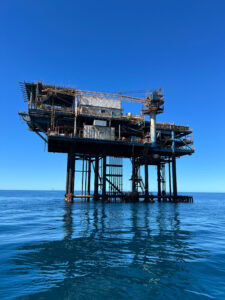
WPF was engaged by Santos in 2024, then McDermott, in 2025 to deliver a A$17 million offshore decommissioning project for the Harriet Alpha platform; this would become the largest offshore structure ever removed from Australian waters.
Installed in 1985, the Harriet Alpha platform comprises of an eight-legged jacket substructure, four topside modules, and nine wells requiring Plug and Abandonment (P&A). Given the size, age and location of the asset, the project required a highly structured and safety-led approach.
Across a 26-month program, WPF safely prepared, inspected, modified and in conjunction with McDermott, removed the Harriet Alpha platform for Santos. Key services included:
- Workshop fabrication support
- Specialised tooling design and testing
- Inspection and Non-Destructive Testing (NDT) and reporting
- Rope access execution in an offshore environment
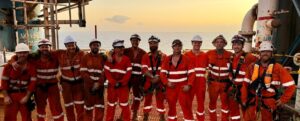
The project was delivered across five clearly defined phases, each designed to progressively reduce risk and prepare the asset for final removal.
Five-phase delivery approach
Phase One: Preparatory make-safe works
The first phase focused on making the Harriet Alpha platform safe for further offshore works and access. Key activities included isolating electrical systems, de-energising equipment, confirming structural integrity and mitigating hazards. WPF’s Naval Base workshop fabrication facilities supported these activities.
By the end of Phase One, WPF had successfully re-established safe access and egress for personnel, enabling subsequent Decommissioning phases to proceed efficiently.
Phase Two: Plug and Abandonment (P&A)
Phase Two involved the design and manufacture of specialised tooling to support P&A activities. These tools were critical to safely plugging and permanently isolating wells in compliance with offshore decommissioning regulations.
WPF’s custom tooling enabled reliable sealing, capping and verification of well integrity, ensuring long-term environmental protection.
Phase Three: Asset integrity inspection and NDT reporting
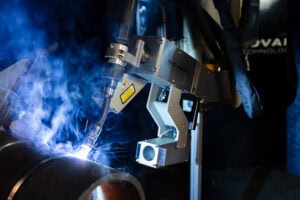
Following P&A, WPF completed comprehensive asset integrity inspections and NDT. Purpose-built work packs were developed for Close Visual Inspections (CVI), dimensional checks and advanced NDT techniques including:
- Eddy Current Inspection (ECI)
- Magnetic Particle Inspection (MPI)
- Ultrasonic Testing (UT)
- Positive Material Identification (PMI)
NATA-accredited NDT reports were delivered, alongside assessments for Naturally Occurring Radioactive Materials (NORM), residual Hydrocarbons and Hazardous materials (HAZMAT). These findings confirmed the platform was safe, compliant and ready for dismantling.
Phase Four: Weight shedding and structural strengthening
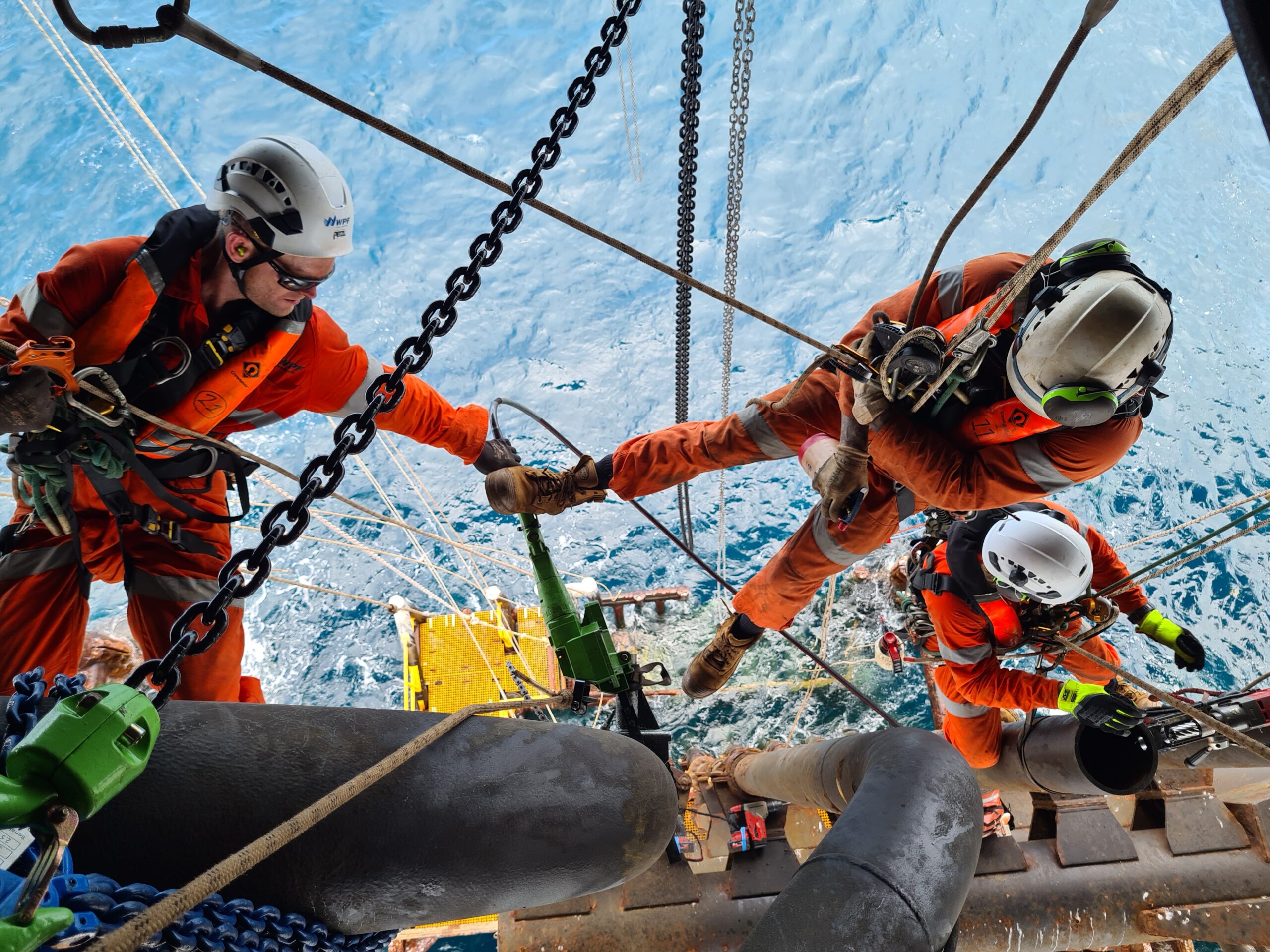
With inspection results reviewed, WPF removed non-essential components to reduce platform weight and simplify final removal. Rope access solutions were deployed in place of scaffolding, improving efficiency and cost for the client.
WPF’s offshore rope access teams were deployed from the LV108 vessel to perform multiple complex removal scopes, reducing overall platform weight and minimising rigging clashes during final cutting and removal activities. Demonstrating strong onshore–offshore collaboration, WPF’s onshore project management team provided real‑time design support to ensure all weight‑shedding activities were completed without compromising structural integrity.
Phase Five: Cutting and removal
The final phase involved cutting the platform from its foundations and executing the largest offshore platform lift in Australian waters. Using the DLV200 heavy lift vessel – 184 metres long with a 2,000-tonne lifting capacity – the platform was progressively cut and lifted onto a barge.
Once removed, the structure was transported 780 nautical miles to Henderson for further disassembly and scrapping; 2944mT of steel was recovered, demonstrating the project’s strong sustainability outcomes.
A full-service offshore Decommissioning capability
The Harriet Alpha project demonstrates WPF’s end‑to‑end offshore decommissioning capability, encompassing planning, design, fabrication, NDT and inspection, and specialist access services.
Through a carefully sequenced programme of works, WPF successfully prepared the platform for a safe, controlled disassembly and removal, delivering strong environmental protection outcomes for Australia while maintaining cost effectiveness for Santos.
Despite harsh offshore conditions, compressed timelines and complex logistics, the project clearly illustrates why Decommissioning represents a rising tide, and why that tide is firmly in WPF’s favour.
Nishant Agarwalla, Manager of Offshore Projects at WPF, said:
“Being engaged to assist Santos and McDermott on the removal of the largest offshore platform ever lifted in Australian waters provided our team with a significant opportunity to demonstrate WPF’s offshore decommissioning capability.
“Our teams operated across challenging conditions with compressed timelines, managing risk and delivery to the highest standards, both on and offshore.
“We are extremely proud of the professionalism shown by everyone involved and look forward to continuing our work with Santos and McDermott to safely decommission offshore assets, delivering cost-effective and environmentally responsible results.”
Andrew Tennyson, Platform Restoration Project Manager at Santos, said:
“WPF have provide to be the ideal lead contractor on the Harriet Alpha Decommissioning since January 2024.
“The team provided a comprehensive scope over 35,000 hours of high-risk work including engineering support, fabrication, material and equipment supply, as well as specialist access systems.
“Despite the complex work scope, WPF’s safety performance and delivery has been exceptional. I look forward to working with WPF on similar scopes again.”